
Don't put off the paperwork
Keeping track of your parents' personal papers will save you time and angst

Welcome to Care-full, a practical guide to caring for aging parents. Here, you’ll find my tips about how to juggle your caring responsibilities, where to find support, how to navigate government bureaucracy, and how to keep parents safe at home or find the right care facility for them. And – perhaps, most importantly – you’ll realise that you’re not alone during what’s probably your biggest role (reversal) yet!
A word before I start: welcome to new subscribers! I think many of you have found your way to me via a reference in Stephanie Wood’s latest Vamp column. For those of you who haven’t read it, Stephanie has written a beautiful meditation on aging, loneliness and the desire for independence that drives so many people to continue living in their own homes despite the challenges.
My last couple of posts – about changes to federal government subsidies for elderly Australians living in their own homes – are far less poetic. It’s heavy reading but the reforms will have a seismic effect on the way you fund your parents’ support.
I’d love to hear from you about how you are coping with your parents’ care, what you’ve learnt along the way and what you might be struggling with. So, please leave a comment or contact me via email.
I’ve been trying to work out what the aged care reforms mean for my mum. Earlier this week, I was rushing to compile some information about her finances, but I couldn’t find usernames and passwords for one of her online accounts. It was late and I was tired. I thought this little task was going to be straight-forward but twice I was blocked from an account that held a small parcel of shares Mum had received years ago after her insurer had demutualised. Wrong username, wrong password.
Where had I written down the correct ones? Where were the original share certificates?
Like a scene from Dickens’ Our Mutual Friend at Mr Venus’s shop with its dusty shelves and mysterious recesses full of yellowed papers and piles of letters tied with old ribbon, I scrambled through manila folders, cardboard boxes and cabinet drawers looking for what I needed.
I eventually solved the problem with much swearing and some help from my partner – let’s call him The Scotsman. In fact, I had worked all of this out 12 months ago but had not written anything down. My minor meltdown served as a salient reminder that I don’t have all of Mum’s affairs in order.
If you’re anything like me, much of the time you spend caring for your parents is spent on day-to-day tasks that you don’t feel you can let slide: GP appointments, vaccinations, fixing broken appliances, cooking meals, grocery shopping or clearing out-of-date food from cupboards and fridges. I’ve got an appointment with the black gunk lining the bathroom vanity at her place that I am not looking forward to. Like me, you probably arrive at your parents’ home with a short list of important tasks only to be diverted by something that seems more urgent.
And so, the paperwork gets left to one side. Old phone bills, bank letters about expiring credit cards, the customer reference number for Centrelink … all shoved into a big black box marked ‘Needs filing’.
I do have some of those nice-looking magazine files from Officeworks in which I store key documents and information. But earlier this year, when I needed to prove Mum’s identity at one of her banks (now there’s a story I’ll have to share later!) I could find neither her passport nor her driver’s licence and the bank wouldn’t accept her birth certificate because it was – not surprisingly – in her maiden name, not her married name. Argh!
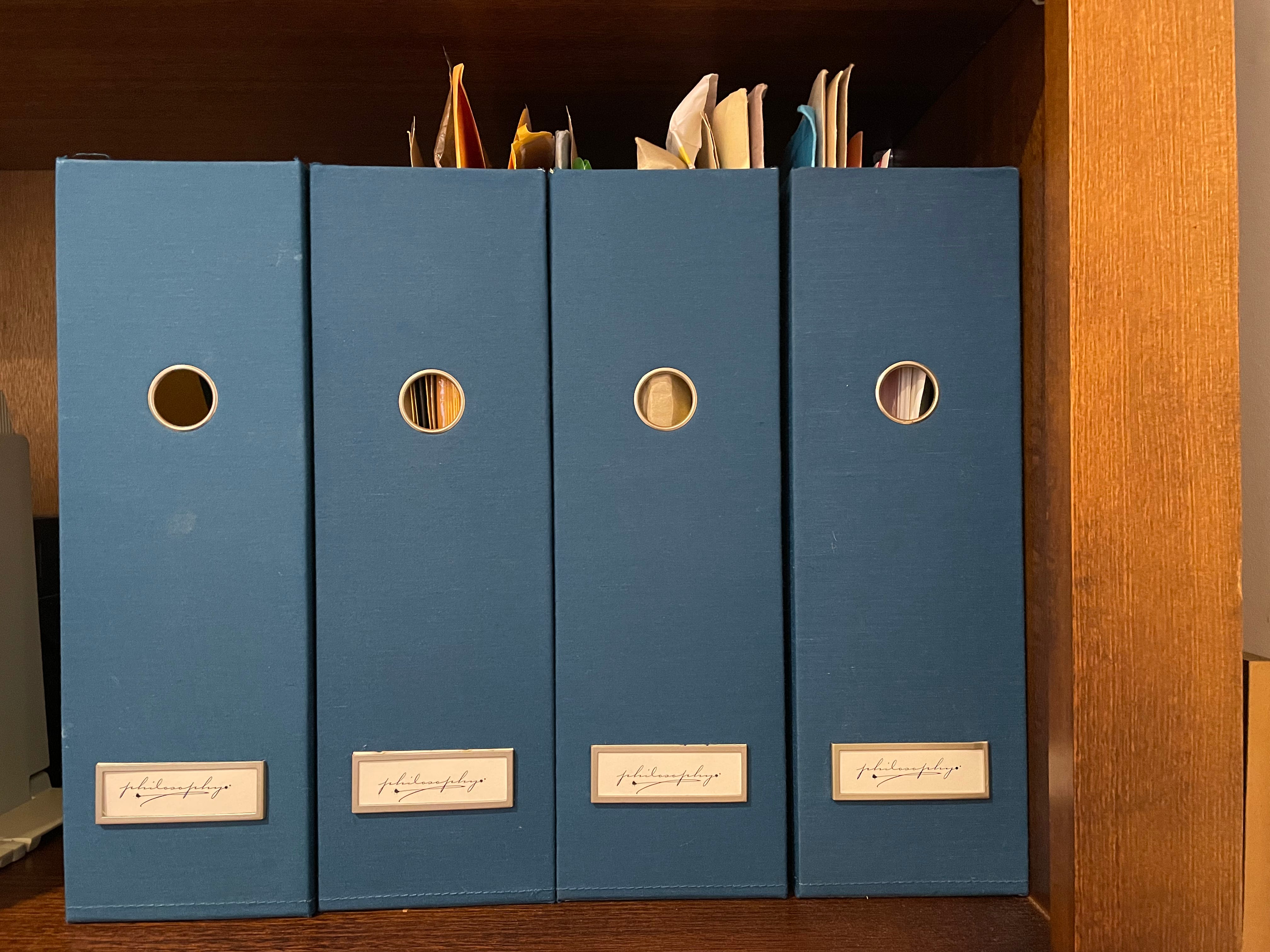
You can store some documents online and original documents at home. But everything should be categorised and stored safely.
The key is having everything in the same place. There will be times when you’ll need to quickly lay your hands on information about your parents’ financial and personal status, or their medical care. For example, if you are thinking about looking for a place in residential aged care, there will be reams of forms to fill out that demand everything from Medicare and pension numbers to residential aged care referral numbers.
And of course, you need to know or know where to find your parents’ online passwords and phone pin numbers if the time comes for you to completely take over their affairs or handle their estate after they die.
You can read more about that in this Care-full column from a couple of weeks ago about our digital afterlife.
As for everything else, here’s a few tips:
Create master lists: account numbers, usernames, passwords, contact details for GP and medical specialists, banks and other institutions; find or know where to find your parents’ passports, driver’s licences, birth certificates, senior and Opal cards
Organise documents: resist the temptation to dump them all in one box. Use some kind of filing system and create categories for key documents such as deeds, property titles, insurance policies, medical cards, household accounts such as gas and electricity, and so on
Identify all sources of income, investments, debts and real estate – you’ll need to know that if you are handling a deceased estate
Set up automated payments for bills
Regularly review bank statements with your parents to check for unfamiliar charges. If you find any, report them to the financial institution ASAP.
Another helpful way of keeping track of your parents’ affairs, especially their health, is to diarise it. You can share this with siblings or others in a Google doc or something similar or in a plain old notebook. Several years ago, I began recording details about my mum’s health in an A4 notebook. As the months went by, it filled up with details about GP and hospital visits, things I needed to fix in her apartment, ideas about better food options for her, and legal arrangements my sister and I needed to put in place to continue to care for her.
The original idea was to have a record of what had been done for her and what still needed to be done. Sometimes, there is more than one leaver to pull to complete a task so it helps to list what needs to be done or investigated, and what’s been achieved so far.
The notebook is also handy for GP visits; I can tell Mum’s GP if her vertigo has returned or how she has reacted to new medication.
This notebook has also become a sort of diary detailing how Mum has changed. In 2022 she was still driving, doing her own shopping, going to the movies … the changes from then to now make me feel sad but also, I can’t ignore what the changes mean for her ability to live independently.
I’m a dinosaur. I write ‘to-do’ lists on paper, I print things from the computer, and I keep a little diary in my handbag. But whichever way you choose to keep track of your parents’ paperwork, don’t put it off.
More reading
How should I secure my important documents?
Safe keeping of important documents - don’t wait until it’s too late
Supporting documents for an aged care costs calculation
Today’s totally-unrelated-to-caring offering
Reading fiction has always played a big part in my life. I have less time for it these days and less patience with novels that don’t quickly suck me in to their orbit. A friend recently recommended a book by an Irish writer I had not heard of – Time of the Child by Niall Williams. The film Four Letters of Love, released here earlier this year, is based on one of his other novels (I’ve not seen it nor read the book). In Time of the Child, with beauty and pathos Williams tells the story of how people cope with loss and their lot in a small village in 1960's Ireland. As Molly Meldrum used to say, do yourself a favour and get a copy.

Thanks for reading Care-full. If you have enjoyed this post, please give it a [heart], which will make it more visible to new readers. Subscribe for free to receive new posts every Saturday and to support my work.
Wendy Frew is an Australian journalist, author and community broadcaster whose work has appeared in the Sydney Morning Herald, the Australian Financial Review and the BBC, and on 2SER and Radio Northern Beaches. She is the primary carer for her beautiful nonagenarian mother. She wishes she could fly like a Peregrine falcon.
Thanks Wendy. Another valuable reminder of what can make a difference at a stressful time.