
Basic instincts
What’s the bare minimum we should expect from aged care homes?


Welcome to Care-full, a practical guide to caring for aging parents. Here, you’ll find my tips about how to juggle your caring responsibilities, where to find support, how to navigate government bureaucracy, and how to keep parents safe at home or find the right care facility for them. And – perhaps, most importantly – you’ll realise that you’re not alone during what’s probably your biggest role (reversal) yet!
Just a quick note to say I’m taking an Easter break so there will be no Care-full column on 4 April. Enjoy the chocolate!
Earlier this month, one of Australia’s major tabloid news outlets applied a blowtorch to the backside of a residential aged care provider for depriving elderly residents of ‘sweets, hot brekkie and TV’.
The original story is behind a paywall but from what I can tell, one care provider had started charging residents for personal access to televisions and free-to-air TV channels in their bedrooms, and for hot meals at breakfast.
The story was met by outrage all round and the minister in charge of aged care was interviewed by all and sundry about what he knew about this case, why it had been allowed to happen and what he was going to do to fix it.
It’s a story that taps in to a deep vein of anger and anxiety felt by aged care residents and especially by their families. Fees to enter an aged care home in Australia were already high before the government changed the rules, last year. Back then, optional extras cost anywhere from $40 to well over $100 per day for things such as pay TV channels, wine with dinner, and daily newspapers. There were plenty of stories about the “optional” extras not being optional at all.
After the aged care act was amended in November, the cost of entering an aged care home rose even higher and the system became more complicated.
But one of the trade-offs was supposed to be a tightening of the rules around charging for these so-called optional extras: nursing homes were now not allowed to charge for them unless a resident wanted the extra services and agreed to pay for them.
The aged care act now makes it clear that these services must go beyond standard care, and paying for them can not be a condition of entry to a home.
What’s the difference between basic and optional services?
Basic services, known under the Aged Care Act as everyday living services, are partially or fully funded by the government depending on a resident’s means, and include the following: operational administration and emergency assistance; communication services; utilities; cleaning services and waste disposal; bedroom, bathroom furnishings and toiletries; laundry; and meals and refreshments.
But it’s only when you dig down into the boring details of the legislation that the picture becomes clearer. For example, “communication services” is defined as access to “but not including any usage charges or device costs” for a telephone or wifi in your room. So you can access it but it’s only going to work if you pay for it.
The act does stipulate that basic services must include “heating and cooling for bedrooms and common areas to a comfortable temperature”. But televisions are listed as a “communal furnishing”, so, not something you can guarantee will be in your bedroom. Too bad if you are bed bound.
There’s a lot of detail about meals and refreshments and the list stipulates “at least” three meals each day, with dessert, plus morning, afternoon tea and supper – but not alcohol. But it doesn’t say breakfast has to be a hot meal.
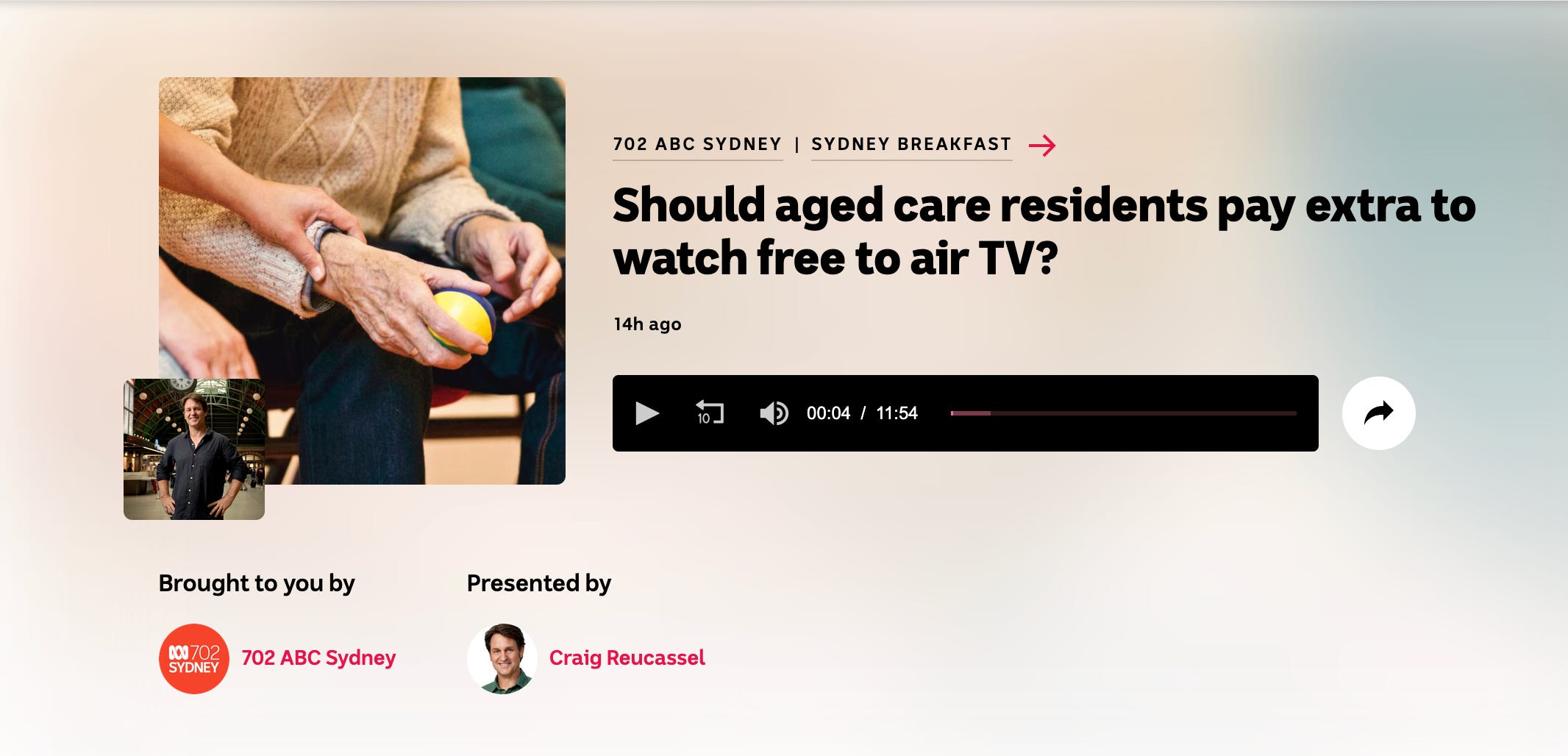
Regarding the aged care provider that coped an angry media serve, I couldn’t find a statement on the company’s website about this issue but Australia’s Minister for Aged Care and Seniors, Sam Rae, described the provider’s policy change as “disgusting”. He has asked the Aged Care Quality and Safety Commission to investigate.
“I think access to free-to-air television and information is absolutely a right that people have and should be provided for,” he told the ABC.
He told other media access to a TV was a “basic human right”.
Which – after a long-winded journey, sorry! – leads to my question: what is the bare minimum a residential aged care home should provide to our parents before it can start charging them extra money? Do we need to explicitly detail that bare minimum in the aged care act? Should it include not just free-to-air TV but also access to wifi? After all, we live an age when young and old are connected to the internet in one way or another - it’s an integral part of many peoples’ lives.
Should the aged care act list access to free-to-air TV and the provision of air-conditioning in every bedroom rather than lumping these things under “utilities” or “communications services”? If we don’t have detailed lists, will some aged care providers look for loop holes?
I’ve included a link (in the caption for the screen shot higher up this page) to an interview on ABC Radio Sydney with the minister, Sam Rae. It’s worth a listen. One of the things he said was that the Higher Everyday Living fee was supposed to be a sensible approach to making it easier for older people to understand what extras they can get beyond the basic care and essentials. Like a nice glass of wine with dinner.
You’ll hear a phone call to the station from a woman about her 102-year old mother. The elderly aged care resident didn’t know how to access wifi, didn’t like air-conditioning, and ate pureed food that was luke-warm anyway so, argued her daughter, she shouldn’t be charged for a hot breakfast, or wifi and air-con.
I mean, really? There’s only so much a care home can do to personalise the service. It’s one thing to only order 10 copies of the local paper every day because you know there are only 10 residents who are paying for it under their optional extras. But wifi is for the entire building. Is it reasonable to break that down to what it costs for each room? As for the air-con, we can all imagine the outcry if some elderly people were installed in bedrooms without air-conditioning. Sure, they might not like air-conditioning but in this country, they could, literally, die without it.
If you think I’m barking up the wrong tree, PLEASE comment below. I think it’s a discussion we need to have around the broader issue of what we owe our elderly parents and who should pay for it.
Thanks for reading Care-full. If you have enjoyed this post, please give it a [heart], which will make it more visible to new readers. Subscribe for free to receive new posts every Saturday and to support my work.
Wendy Frew is an Australian journalist, author and community broadcaster whose work has appeared in the Sydney Morning Herald, the Australian Financial Review and the BBC, and on 2SER and Radio Northern Beaches. She is the primary carer for her beautiful nonagenarian mother. She wishes she could fly like a Peregrine falcon.